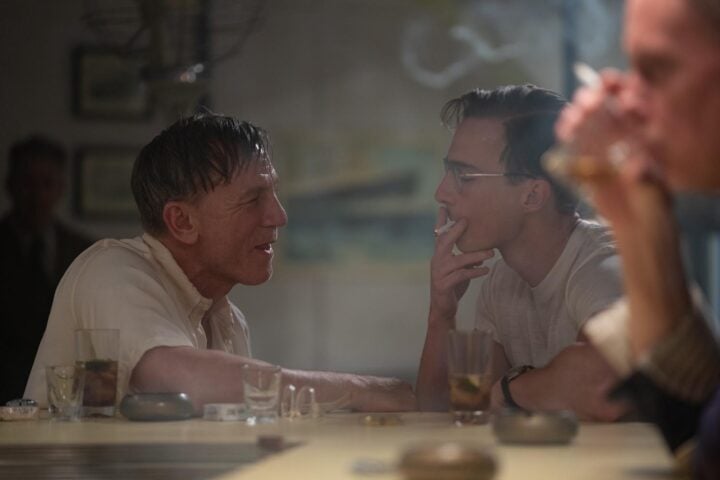
There’s a moment during The Man Next Door where Victor, the boorish character played by Daniel Aráoz, invites his next-door neighbor Leonardo, a successful architect who lives in Buenos Aires’s Casa Curutchet (the only residential house designed and built by Le Corbusier in the Americas), to a bar so they can iron out their differences, but refuses to go to the one on the corner because there are too many “negros” there. The word, whose insult is proportional to the harshness of its intonation if you speak Spanish, is curiously translated on screen as “redneck.” People at the film’s press screening laughed at Victor when they should have scoffed at him, since the relaxed manner in which he says the word reveals him to be as problematic a citizen of the world as his condescending neighbor. The sketchy translation makes cute what should have been repulsive.
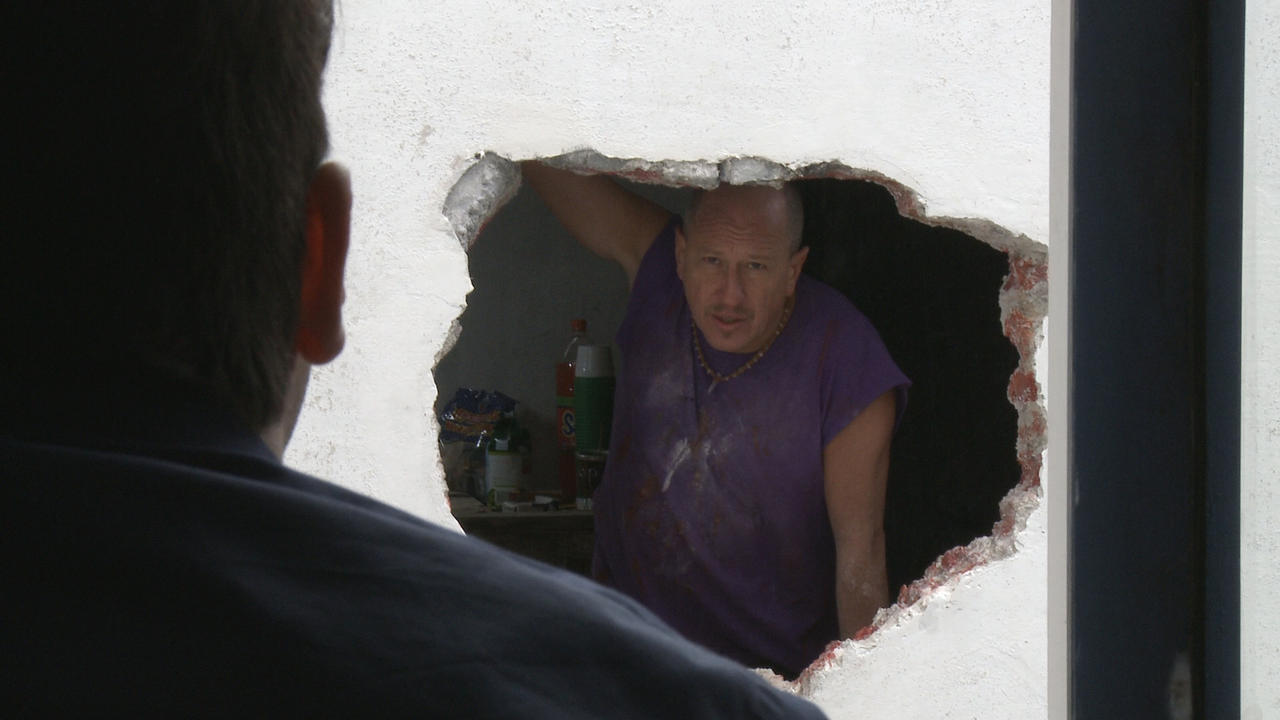
The film opens with the heady shot of a wall being sledgehammered on one side, the part painted black, with such force that that it creates a hole further down the wall, on the part painted white. This visual motif, like much of the film, feels neat, as it so easily and concisely reduces the film’s conflict to a symbol. But in the story, it isn’t black that’s pitted against white, but the uncouth against the refined, after Victor starts knocking down part of a wall in his home to make a window. In a show of gross haughtiness, Leonardo objects to the construction, claiming that it’s illegal and that it allows Victor to peer at his wife and daughter’s nakedness, when it’s obvious that his real objection is to how the window disrupts the symmetry of the Curutchet’s Zen-like architecture. Peering at the darker-skinned man in charge of making the window, Leonardo even makes a comment about the terribleness of his country.
The home, a pretentious repository of Eames-era décor, is itself a symbol: a representation of the coldness and aloofness of snobs like Leonardo, who devotes his life to purposefully complicating the function of common furniture and derives pride from building walls between people. He treats his servant all right, but his daughter inexplicably doesn’t speak to him and his equally repugnant wife doesn’t fuck him, seemingly content with the occasional peck she asks for while he’s at work on his computer. After trying and failing to appeal to Leonardo’s common sense and decency, telling him that his window is for the sake of absorbing a little sun, Victor gives up on the window, though in its unfinished state it continues to wreck havoc on Leonardo’s mind. What Victor represents—and obviously so—is an affront to Leonardo’s blinkered sense of complacency, a barbarian at another barbarian’s gate, the Bugs Bunny to his Elmer Fudd, a constant gnawing at his conscience.
But Victor’s behavior, the good spirit with which he takes Leonardo’s anti-window crusade, feels unrealistic. He’s too much a conceit on the filmmaker’s part, for a man of his credible crudeness, and one with such a highly tuned bullshit meter, probably would have told Leonardo to shove something up his ass before putting up with his arrogance. His repeated attempts to befriend Leonardo, even when the architect has threatened to sue him, even when the architect has insulted his mentally-handicapped uncle, seem to have no effect on the man or his behavior, even after a predictable incident fortuitously lures Victor into Leonardo’s home. The filmmakers unimaginatively and redundantly, though sometimes amusingly, elucidate on two age-old adages: about how men who live in glass houses shouldn’t throw stones, and how the more things change the more things stay the same. But the thing they do simplest of all is repeatedly call out Leonardo’s incorrigible arrogance—and it becomes like shooting fish in a barrel.
Since 2001, we've brought you uncompromising, candid takes on the world of film, music, television, video games, theater, and more. Independently owned and operated publications like Slant have been hit hard in recent years, but we’re committed to keeping our content free and accessible—meaning no paywalls or fees.
If you like what we do, please consider subscribing to our Patreon or making a donation.