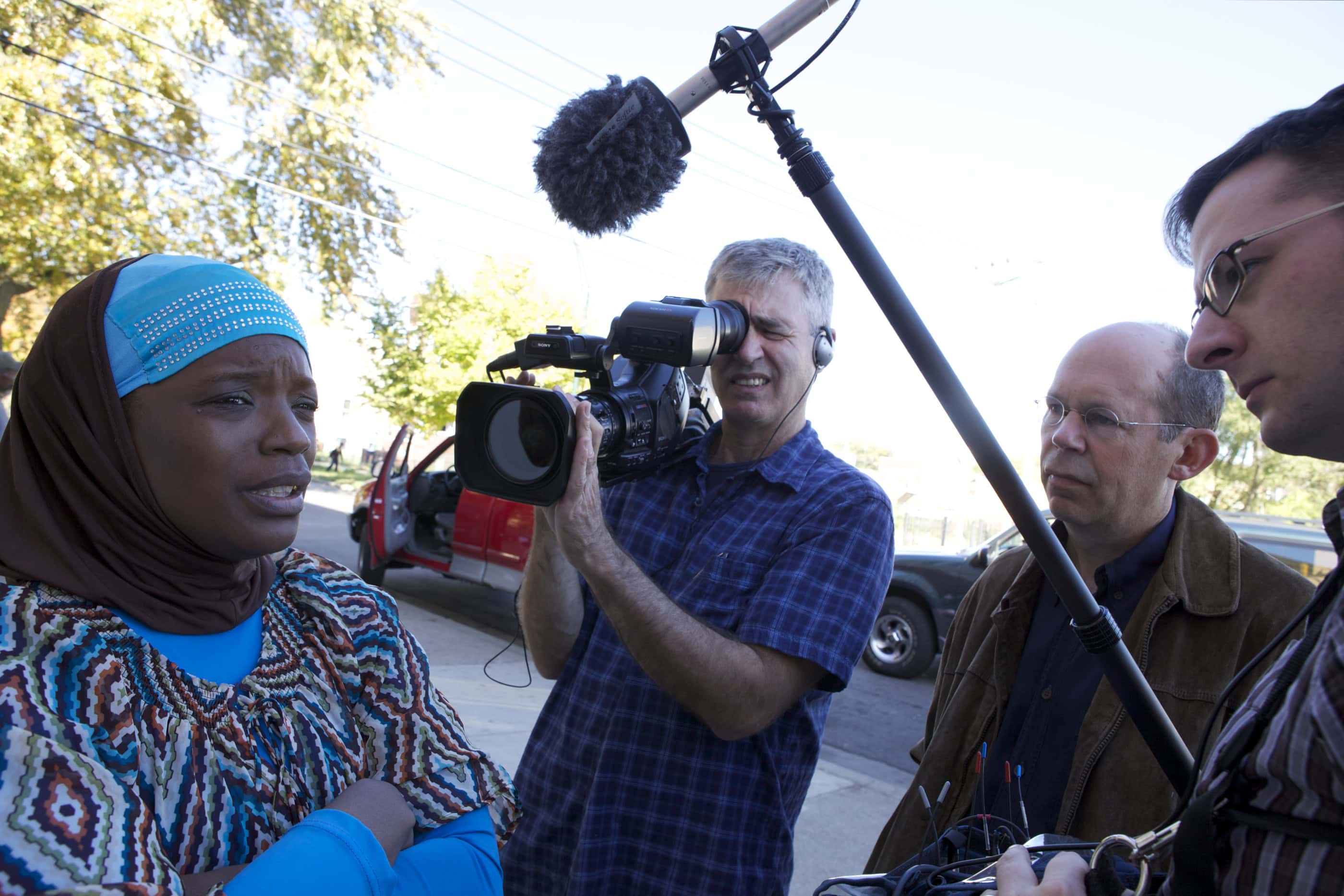
It’s hard to imagine a better pairing of talent and material than Steve James, Alex Kotlowitz, and the street-savvy, impassioned antiviolence crusaders of The Interrupters. The documentary addresses a problem that couldn’t be more serious (the violence that literally plagues the streets of Chicago and other American cities), but talking to its open, unpretentious filmmakers was a lot of fun. That’s partly because James likes to tease Kotlowitz, noodging his longtime friend out of the somber sincerity that seems to be his fallback position. It was also nice to hear that Kotlowitz had fond memories of my husband, who hired him in the ’80s to write copy to accompany a photo essay on children living in Chicago’s Henry Horner housing project for Chicago Magazine (Kotlowitz parlayed that assignment into his excellent book on the subject, There Are No Children Here.)
So, Alex got this started with your New York Times article. How did you initially find this group?
Alex Kotlowitz: It goes back to your husband, in some ways. I say that because, working on There Are No Children Here was about following these two boys over the course of two years, but in many ways it was about the violence that affects their lives, and that was pretty overwhelming. I remember being pretty depressed in the midst of that, and subsequent to the book coming out, three of the kids I befriended were murdered. It haunts you.
I’ve been trying to figure out a way, as a storyteller and as somebody who cares about these issues, to figure out a way to grapple with it. And then this guy that worked with them who I play basketball with convinced me to go spend some time with CeaseFire, and I came away impressed.
I think there are two things that really most impressed me. One, that it offered a different way to look at the violence. Gary Slutkin, who founded CeaseFire, is an epidemiologist who looks at violence as an infectious disease. That takes the moral judgment out of the equation, so it’s not about good and bad people, and I think that’s really important. And the other thing is that I began to spend time at that Wednesday meeting where the interrupters gather every week, and after that first meeting I was hooked. You look at the faces of all of these men, and there are a couple of women there, and you just think, my God, there’s just a bundle of stories there.
And 500 years of prison time.
Kotlowitz: [laughs] Right. So I ended up doing a story for the magazine about it, and it was one of those rare experiences as a writer where I felt, boy, if you could get the kind of access you need, this would be a great film. I knew the access would be tough. One of the things that eluded me in working on the magazine piece was getting at the personal stories of the interrupters. It was one of the things that really intrigued me.
Well, you sure got it. I often found myself watching a scene and thinking: “Damn, there was a camera in here?” You get into the middle of some pretty deep stuff, and you obviously had to develop real trust to get that kind of access.
Kotlowitz: The access question was not so much a question of trust. Partly, but it was really a question of whether you were going to compromise their situations—
Steve James: Whether they’d let us close with a camera. These are delicate negotiations, some of them, and there are legal issues involved.
Did you start with the individual interrupters you wanted and then follow them, or did you look for dramatic mediations and then follow whoever happened to be involved?
James: We knew from the get-go that we wanted to follow interrupters, but we didn’t know which ones or how many, except that we knew we didn’t want too many. We knew Ameena was one, and then the process became one of filming the meetings they had every Wednesday. That helped with getting our finger on the pulse of what was going on week to week and getting them comfortable with us. That was also our way into getting to know more of the people around the table.
Tio Hardiman, who created the program, would tell these guys about us every week. He’d say, “They’re here, they’re trying to make this film; it’s important to us that we do this film. I want you guys to step up and get them into some mediations.” Cobe was the guy who really took it to heart and started calling us. We didn’t even notice him at the table until he started calling us. He wasn’t a guy that took over the room. He’s a gregarious and wonderful and funny guy, but not a guy that just kind of jumps out at you in a meeting.
Like China Joe.
Kotlowitz: Yeah, China Joe!
James: China Joe was one of the guys we were interested in, but it just never happened with him.
Looking around that table at those meetings, it’s striking how charismatic most of these former gangbangers are—so good looking and smart and personally powerful. It makes you wonder if some of the best and the brightest people in that neighborhood became gangsters.
Kotlowitz: Well, they were the leaders. Each of them, in their own right, were leaders when they were in the gangs. People would listen to them, just as they do now. One of the things Steve and I talked about is, the easy thing to say would be that they’ve changed, but in many ways I think they’ve figured out who they were all along, using all the same skills and tools and assets that they had back then, just for something very different. So you’re absolutely right. There’s no question. When Cobe was running the streets, that affability, that humor, that disarming nature—it got him places.
James: He wasn’t that threatening leader. He’s the best kind of leader. He’s the guy you want to do right by because he’s a good guy and he’s a fair guy and he’s a man of his word. And Ameena, of course, you can see that powerful charisma that would make her a good force. It’s almost like she took her dad’s power and charisma. [Ameena’s father, Jeff Fort, was one of the most famous and powerful gang leaders of his time.] And now look what she’s doing with it.
Kotlowitz: You had asked whether certain people jumped out at us. We pursued Ameena, in fact, Steve and I would joke early on about how it reminded us of high school, chasing some beautiful girl. She would sometimes return your call and sometimes she wouldn’t—
James: I was calling her for a while and then she wouldn’t call me back, so I said, Alex, you call her, since she wouldn’t recognize the number. That worked once. [laughs]
Kotlowitz: With Eddie, we knew we wanted a Latino. And Eddie, of course, is this incredibly thoughtful guy, who’s still wrestling with—
Doing penance, basically, every day, for having killed someone when he was on the street as a kid.
Kotlowitz: Yeah, trying to find a way to forgive himself. He constantly questions himself, and he’s also questioning CeaseFire. He believes in their philosophy, but he asked questions about what they’re doing.
James: “Are we a Band-Aid?”
Kotlowitz: Yeah. It was really important to have that self-questioning voice in there.
He was also great with kids, as were all three of the people you followed. You’ve both done a lot of stories about people who never really got to have a childhood. In this film, a lot of why the interrupters want to do what they’re doing is that they regret what they did when they were young. They want to help other young people who are falling into the same trap, and they understand the importance of having a supportive adult in your life. [To Alex] I mean, the title of your book was There Are No Children Here. Are you conscious of that as a theme in your work?
Kotlowitz: I hadn’t really thought about that, but I think you’re right. I think it’s a really interesting observation. You do see that here, certainly with Eddie. He talks about when that young girl is crying because she’s seen a shooting, about not wanting the kids he works with to have to go through what he’s been through. He identifies with them.
And Ameena identifies with Caprysha, the girl she’s working with.
Kotlowitz: Right. She tells her at one point, “You’re a little Ameena.” I think that’s what makes the interrupters so effective, their ability to put themselves in the shoes of these kids.
James: One of the themes I’ve noticed, not just in the films I’ve done, but really in life—because there’s a difference, not much, but a little—is that the people that make seemingly profound change in their lives, like the interrupters, have a real anchor at a crucial moment in their life. With the kids from Hoop Dreams, it was their mothers. With Ameena, it was her grandmother. With Cobe, it was his grandparents. With Stevie, it wasn’t there.
I think what’s really moving to me about what the interrupters are doing is that they’re trying to fill a vacuum in these people’s lives. You see this especially strongly with Caprysha. [Ameena] is, in essence, trying to be that surrogate mother.
Yeah. And with Cobe and Flamo. At the end of the movie, after he’s been turned around, Flamo tells Cobe something to the effect of: “You just would not give up on me. You kept calling and coming around.”
Kotlowitz: Absolutely.
James: It’s crucial. That’s why we picked that song at the end, Solomon Burke’s “Don’t Give Up on Me.” Jack Piper, our co-producer, found it, and we felt like it really encapsulated what we want the audience to walk away with. Which is: Don’t give up on the Flamos of the world. Don’t give up on these communities. Don’t give up.
In the past, both of you have generally told stories to middle- and upper-middle-class people about low-income people. You could say the message was always “don’t give up”—don’t demonize these people, don’t write them off, don’t oversimplify or overlook them or just give up on them. The Interrupters could work for those same audiences in that same way, but it seems like it could also work for the people in communities like the one that’s being portrayed, give them ideas and inspiration that could help them improve their lives. I know Kartemquin likes to use its films as a catalyst for community organizing. What do they have planned for this one?
James: We totally agree. This is a film that can work for those two audiences, in a big way. One of the many great things about Kartemquin as an organization is that they take seriously the whole civic outreach part of filmmaking. They just did an outreach with The Interrupters a couple weeks ago in Chicago, where they brought together about 80 kids who are part of various youth media groups in Chicago. These are kids from the same kind of neighborhoods that this film takes place in. they watched the movie, and they went for it big time. They were like, this movie needs to be in my school; people need to see this movie. They were laughing at the funny moments.
Kotlowitz: Another great thing is that, in Chicago, the film opens in the Siskel, but it’s going to open at the I.C.E. theaters in Lawndale and Chatham, which are similar to the neighborhood where we shot.
James: Chatham is just a little south.
Kotlowitz: And Lawndale is on the west side.
Are you going to go to those openings?
James: Our V.I.P. premiere of the film, which is on the 27th of next week, is at the Chatham I.C.E. theater, and Cobe’s aunt is catering it. And we’re going to have everybody who’s in the movie there.
[To James] You said in the press notes for this film that you became a documentary filmmaker because you “wanted to understand people and communities other than the ones I’ve lived in.” I was interested to see that because I have this theory that all really good filmmakers make movies partly to learn more about whatever they’re filming. So to what extent is that still your driving force? What else have you gotten from making documentaries over the years?
James: Well, I have found over the years that it’s not always obvious or conscious, but I end up making films about subjects that I am either troubled by or troubled by my own feelings. Like The New Americans, which is an excellent example.
Why The New Americans?
James: Well, this was at a time when there was much debate about where was America going ethnically with all this immigration. And if I looked in my own heart at the time, I had my own questions, if I was really honest with myself, even though I’m a good liberal. Part of what I wanted to do with that series—and it’s not the reason in total we made the series, but it’s what sparked my interest—was to try and understand who the immigrants really are who are coming to American today. With Stevie, I think it’s fairly self-evident what drove that. With Hoop Dreams, it was realizing that I had grown up playing basketball with a lot of African-American players and never really been their friend, just their teammate. And I knew that this game meant more to them—the stakes were higher for them than for me, much as I love the game.
And the same in the Iverson film too.
James: Yeah, in the Iverson film I kind of articulate that. I think, for this film, like Alex was saying with his book, the issue of urban violence has haunted me since seeing Bo Agee [the father of one of Hoop Dreams’s two main subjects] murdered in 2004 and William Gates’s [the other main subject] brother Curtis murdered in 2001 and seeing the devastating impact that both those senseless losses had on those families and those young men. So that was, for me, the personal part of this that made me want to engage with this and try to understand it, just like Alex wanted to understand it. So, yeah, I feel like every film should be an act of discovery.
For the filmmaker as well as the audience?
James: Absolutely. In fact, I think when a film works best, it is, for you as a viewer, the distillation of the years that we spent making it and all the discoveries we made and all the ways that it surprised us.
Alex, you’ve worked in newspapers and magazines and books, but is this the first movie you’ve been involved in?
Kotlowitz: I’ve done TV. I used to be, years ago, a correspondent on the NewsHour and I’ve done some Frontline documentaries. This was my first film.
So how does this film compare to the other things you’ve done as a way of telling your story and getting it out into the world?
Kotlowitz: There’s a real power in doing intimate filmmaking. There really is a sense that you’ve really gotten to know the characters. My big concern going in, given my experience, was twofold. One, the last film I had worked on, we had a seven-member crew going in to film seven people. It felt incredibly unwieldy, even clumsy at times. It took away any sense of intimacy. And the other thing was that we would always—which is common in TV—go in and pre-interview people, so that took out all the freshness and spontaneity from what they said. What I appreciated, working with Steve, is that we kept our crew really small, just three of us: Steve with the camera, and myself, and Zak Piper, our co-producer.
James: Zak did sound.
Kotlowitz: And for the interviews, we didn’t pre-interview anybody, and they were long, often marathon interviews. I think you get the sense of intimacy [created in those wide-ranging talks] in the film. The other challenge with film is that you really have to be there. When I’m writing, I can sit in a room and reconstruct a scene without being there—
James: Yeah, I always used to complain: “That’s cheating! [pretending to mock Kotlowitz] And then you make it sound like you’re the-e-ere.” Which is an art, really, to make people feel like they’re there.
Kotlowitz: So there was something exhilarating about that. For the course of the year when we were filming, we were on call 24 hours a day, essentially. You’re going out at all hours of the day and night. And every time we went out, I felt like there was something new to discover. Another thing that’s been a little scary and also exhilarating is that, when people read my books, they do it in private. If they don’t like it, I’ll never hear, and if they love it, maybe I’ll hear from them, maybe not. But in the film, you’re watching and listening to the reactions as the film unfolds.
James: But, I have to say, it’s been mostly a blast—
Kotlowitz: Right! It’s been a blast! They get it. The final thing is that writing is such a solitary experience, and this was so much fun. I mean, it’s fun to work with Steve, and then also with the interrupters. There’s something to be said for having a collaborative experience.
James: Yeah. Film is an inherently collaborative experience, in the best sense. I must say, it doesn’t get any better than doing this film, even though the subject matter at times was hard, obviously, and upsetting and depressing and tragic. The overall experience, and what we took away from it, was a blessing.
You think you guys are going to work together on something else?
James: Never. [laughs]
Kotlowitz: We’ll probably work together on something else. Probably a fiction film.
Really? [to James] You’d want to do a fiction film? You’ve never done one, have you?
James: Well, I’ve never made a strict fiction film because when Hollywood was willing to let me do some things, they were always biopics. I did the lowest-budget feature in the history of the studio system, Prefontaine, and then I did a couple of cable movies. But they were always biopics—and always sports biopics. That’s what they would let me do.
Kotlowitz: That’ll change.
James: So, yeah, I would like to do a fiction film. We’ve talked about different ideas. ‘Cause Alex wants to write.
Kotlowitz: I want to write.
James: He wants to write a script. [pause] And I want to rewrite it. [laughs]
Kotlowitz: That was a good one.
James: Well, they say writing is rewriting.
Since 2001, we've brought you uncompromising, candid takes on the world of film, music, television, video games, theater, and more. Independently owned and operated publications like Slant have been hit hard in recent years, but we’re committed to keeping our content free and accessible—meaning no paywalls or fees.
If you like what we do, please consider subscribing to our Patreon or making a donation.