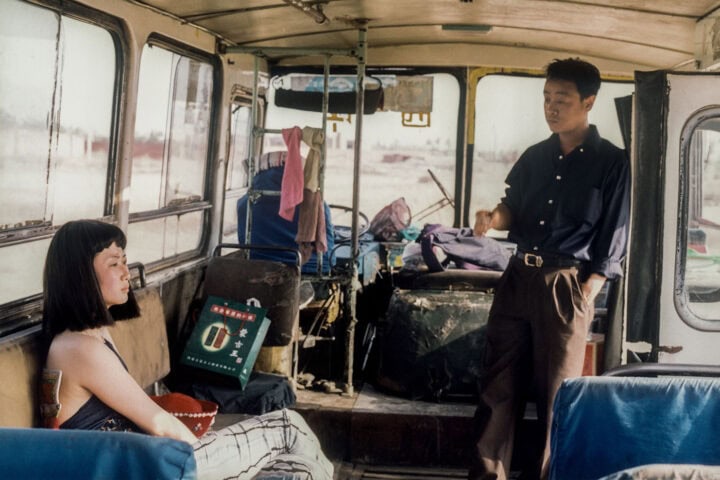
To gauge the suffocating allure of Platform, imagine if the protagonist from Robert Bresson’s A Man Escaped never made it out of his Gestapo hell. Jia Zhang-ke’s epic film is a laconic portrait of a remote Chinese city in arrested development, where love is impacted and lost highways lead to destinations unknown. The film takes its title—and lonely mantra—from a Chinese song popular throughout the ’80s: “The long and empty platform, the wait seems never-ending, the long wagons are carrying my short-lived love.” The conflict here is between national collectivism and individual fortune—the former is struggling to stay alive while the latter fights to express itself. Bellbottoms come to Jinjiazhuang sometime between 1979 and 1989; the adults don’t “get” the pants—they seem inflexible, and as such improper for work. Female passivity is promoted via government-sanctioned sex videos while the sweaty kids of the “birth control generation” bust a move in underground hallways. You can feel the unrest in the air: Trains constantly leave and come into the community, but it’s as if no one rides on them; the tide is changing (Mao is dead and a Western, market-driven pop awareness is slowly seeping in), but no one seems to be going anywhere quick. Atop the cement platform that overlooks the city, a couple engages in a courtship repeatedly frustrated by unbending parents, defeated selves, and bitter surroundings (at one point, cement pillars make it difficult for them to share the same frame). The distant mountains signify hope, as does a ravishing, impromptu flame, but you get a sense that Jia’s lost generation needs a little more time to figure things out. (They’re somewhat closer once Unknown Pleasures rolls around.) Some critics have complained about the film’s lack of narrative vigor, forgetting that Jia’s point is that there’s very little for these people to live out. These are lives trapped in amber, trying to create a more complex narrative. Via startling long shots and temporal displacements, Jia truly evokes a community grasping hopelessly for something, anything to lift them up.
Since 2001, we've brought you uncompromising, candid takes on the world of film, music, television, video games, theater, and more. Independently owned and operated publications like Slant have been hit hard in recent years, but we’re committed to keeping our content free and accessible—meaning no paywalls or fees.
If you like what we do, please consider subscribing to our Patreon or making a donation.