
In January of 2024, Irish barrister Blinne Ní Ghrálaigh soberingly suggested that Israel’s actions in Gaza constituted “the first genocide in history where its victims are broadcasting their own destruction in real time in the desperate, so far vain hope that the world might do something.” She was arguing at the International Court of Justice, at The Hague, on behalf of South Africa’s claim that Israel was acting with genocidal intent.
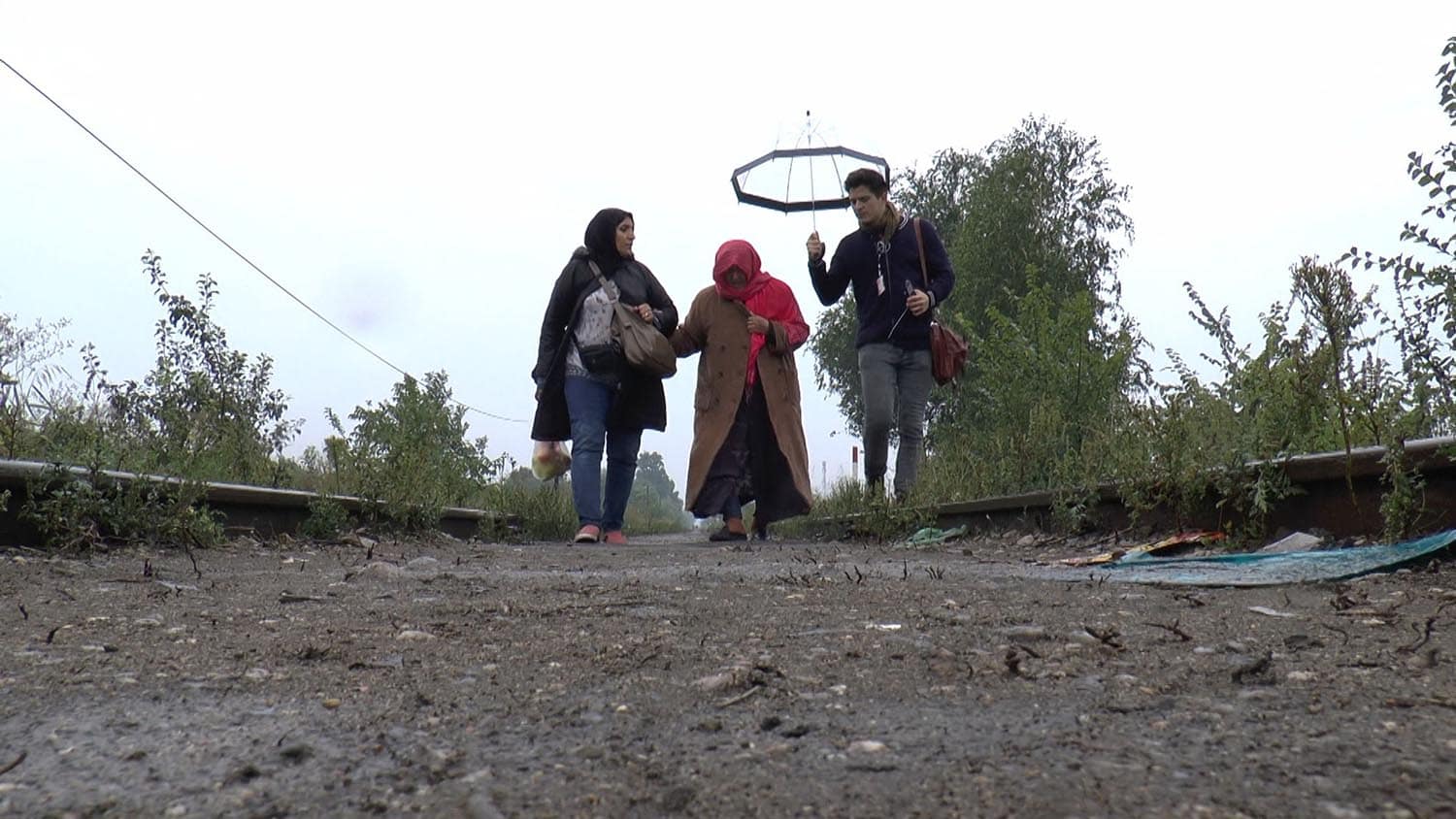
One domino of genocide and ethnic cleansing is mass displacement. For those lucky enough to get out of a war zone, a harrowing journey as a refugee awaits. In his home video-style documentary Notes on Displacement, Palestinian director Khaled Jarrar accompanies a Syrian family on a long and uncertain voyage from Yarmouk Camp, outside Damascus, to Germany.
Terse and frequently nauseating, Notes on Displacement fulfills its title’s promise as a loosely tied-together collection of scenes, diaristic in nature, presenting all the complex and seemingly contradictory emotions of a forced life on the road. The film includes frantic voicemails recorded on capsized boats, as well as cellular footage of throngs of refugees rushing to board a ship in Greece headed toward mainland Europe. It’s a harrowing portrait of an uncommon reality, but Jarrar is wise to offer moments in which his subjects play cards, tell stories, and share notes on travel, so as to illuminate their desires to restore a semblance of normalcy to their lives.
Nadira, the elderly Palestinian woman at the center of Notes on Displacement, has been a refugee since 1948, when Zionist forces removed her from her home. It’s a story she recounts while crossing, on foot, through the forests of Eastern Europe—a crushing reminder that some people spend their whole lives caught between worlds. But while her multi-generational family and those immediately outside of their circle face immense hardship, they find pockets of joy wherever they can. And the documentary is never more joyful than it is at the start, with 12-year-old Maria commenting that she’s been able to visit “many different and exotic countries,” before asking her father if their journey has been hard for him or if he’s liked it.
Jarrar has a background in visual arts (he also, intriguingly, worked as Yasser Arafat’s bodyguard from 1998 to 2004), and the political bent of that work can be felt throughout Notes on Displacement, which plays like the kind of video art meant to be digested in chunks as you walk through a museum gallery. The film’s lack of cohesion may make it easy to check out of, especially given its ticking off of similar themes, but despite the prosaic nature of that cinematic choice, it justifies itself by emphasizing that many refugees experience life as a standstill.
It may be that Jarrar agrees with the words that Ghrálaigh delivered at the International Court of Justice. But as with any historical atrocity, it matters most how we interpret the story and tell it to those who follow us. Perhaps that’s why Notes on Displacement, in which Jarrar willfully becomes a refugee in order to expose the viewer to one reality of displacement, ends by hovering over Maria’s drawings: As roughly half of the dead in Gaza were children, her crayon interpretations could be as lasting as Jarrar’s digital documentation.
Since 2001, we've brought you uncompromising, candid takes on the world of film, music, television, video games, theater, and more. Independently owned and operated publications like Slant have been hit hard in recent years, but we’re committed to keeping our content free and accessible—meaning no paywalls or fees.
If you like what we do, please consider subscribing to our Patreon or making a donation.


