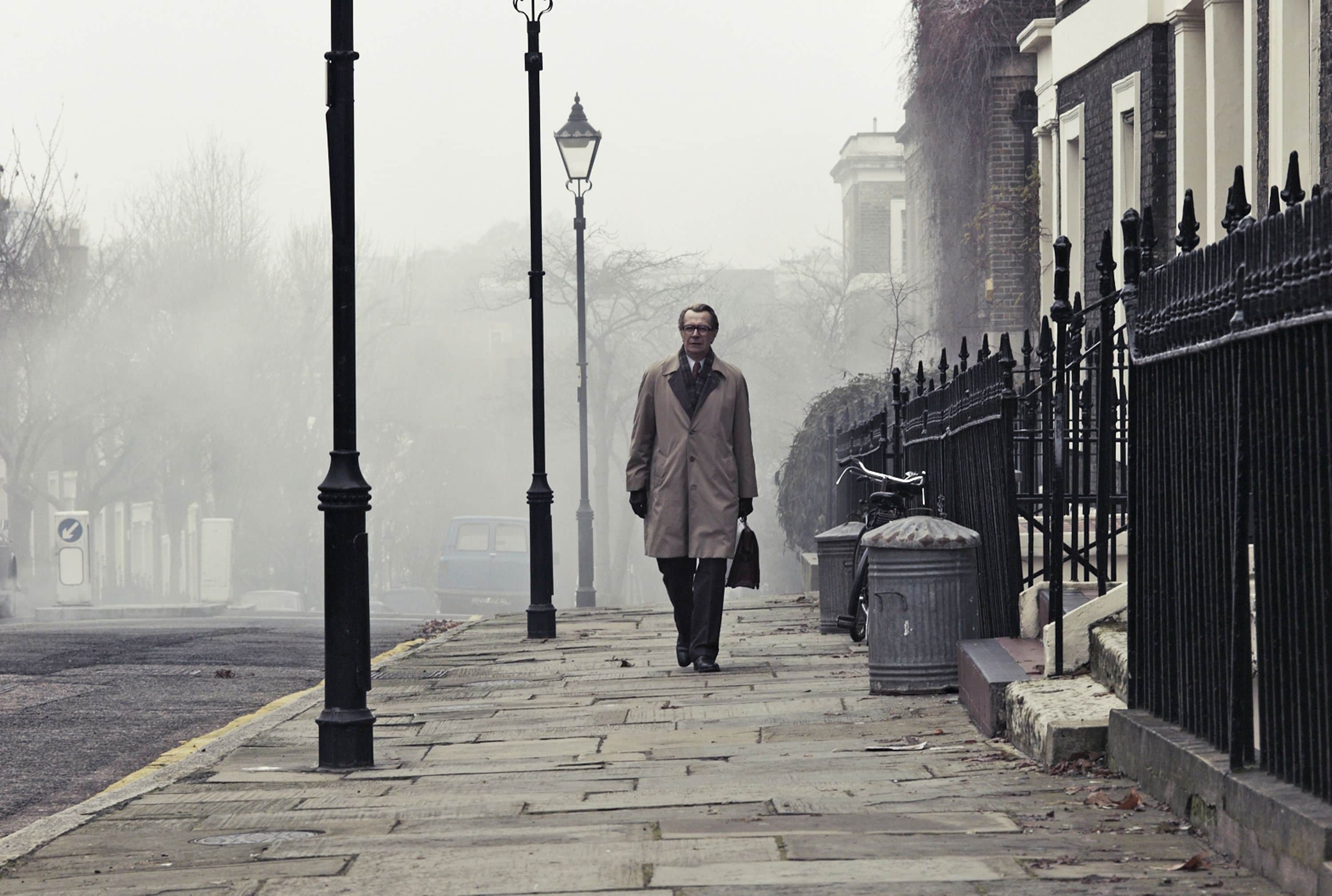
Late in Tinker Tailor Soldier Spy, Tomas Alfredson’s impeccably crafted adaptation of John LeCarré’s classic spy novel, a British agent that was working as a mole for the Soviets offers an explanation for his actions. “It was an aesthetic choice as much as a moral one,” he says of his defection. “The West has become so ugly.” It’s tempting to ascribe the same motives to Alfredson’s directorial choices. After all, he’s gone to great lengths to give his film an eye-popping visual signature, crafting crisp, exacting images out of a perfectly tuned palette of sickly yellows, browns, and toned-down blues, while muting those elements (character, action) that traditionally distinguish the spy thriller. But a more accurate way of evaluating the film’s achievement would be to say that for Alfredson the moral is contained in the aesthetic, his visual scheme no mere eye candy, but perfectly expressive of both the very proper outward behaviors of the characters (the precision of the images) and the sickening moral rot that sat at the heart of the British Secret Intelligence Service during the Cold War era (the color choices).
Set in 1973 in and around the world of the “Circus,” as the SIS is repeatedly referred to, the film builds a palpable sense of distrust, paranoia, and ethical uncertainty. That uncertainty is the result of the realization expressed by several characters that there is very little difference between the West and the Soviets, and that therefore there is no essential tie linking one agent to a particular side. While one SIS member proudly tells a government minister that his organization is the last line of defense against a very real threat, his own motives and practices are everywhere called into question.
But while Alfredson’s film is rich in ambiguity and a generalized sense of apprehension, it almost entirely avoids that spy-movie staple: the explosive set piece. Excluding an early sequence (repeated several times throughout the film from different viewpoints) in which an agent is shot after traveling to Hungary to suss out a mole, all the film’s action is more or less consigned to the realm of the implied. The threat of violence hangs heavy over the film, but it’s only very rarely depicted on screen. Employing a complex flashback structure which often cuts to the past with no explicit indications that it’s doing so, the movie is about the accumulation of information, the fitting together of pieces, and the perpetual rethinking of single incidents to determine the exact nature of those events.
As such the film is at once heavily plotted, fragmented in its cubistic revisiting of certain scenes, and insistently unemphatic in its presentation of the workings of international intrigue. As dry as its stoical lead, George Smiley (a first-rate Gary Oldman), a former SIS agent called out of forced retirement by a government minister to out a mole in the upper echelons of his former organization, Tinker Tailor treats the business of spywork not as a constant James Bond-style orgy of glory-seeking, but a painstaking process of gruntwork. Most of the film consists of Smiley meeting up with contacts, many of whom, like himself, were forced out of the Circus, and listening to their stories which then unfold in splintered flashbacks as our hero tries to piece together a coherent plot. Ultimately, the film is about narrative making, as the viewer is forced, along with Smiley, to process a lot of disparate intel (much of it presented by Alfredson with remarkable subtlety; rarely has a contemporary studio release so respected its viewer’s intelligence) and put it together into a storyline that makes sense.
And yet, when all the pieces are assembled and the impeccable machinery of LeCarré, Alfredson, and screenwriters Bridget O’Connor and Peter Straughan’s narrative is resolved definitively in an enormously satisfying montage that has remarkable resonance without ever overplaying its hand, there remains the sense that nothing has been achieved. Order may be restored to the Circus, the “bad” elements weeded out, but in the jaundiced world the film has spent the last two hours so effectively delineating, the barriers between good and evil have been shown to be essentially meaningless. What makes Tinker Tailor such an effective piece of work is not only its understanding that the major world players are virtually interchangeable, sides to be chosen in what amounts to a game of international espionage, but its forceful presentation of this fundamental ambiguity via a coordinated wash of sickly browns and yellows and the slow accretion of atmospheric details that build into a palpable ethical unease.
Since 2001, we've brought you uncompromising, candid takes on the world of film, music, television, video games, theater, and more. Independently owned and operated publications like Slant have been hit hard in recent years, but we’re committed to keeping our content free and accessible—meaning no paywalls or fees.
If you like what we do, please consider subscribing to our Patreon or making a donation.